The Best Japanese Nail Tools for Beginners: A Translated Guide
Japanese nail supply shops are overwhelming. Even online, the sheer volume of products — each labeled in Japanese with minimal English — can stop a beginner cold. You know Japanese nail tools are considered the best in the world. You have seen the results that Japanese nailists produce. But you do not know which of the 200+ products in a nail supply catalog you actually need.
Quick Answer: Starting with Japanese gel nails requires a core toolkit of 10-12 items: an LED lamp (LEDライト), base gel (ベースジェル), color gels (カラージェル), top gel (トップジェル), nail file (ネイルファイル/爪やすり), cuticle pusher (キューティクルプッシャー), cuticle nipper (キューティクルニッパー), gel brushes (ジェルブラシ), ethanol or cleanser (エタノール/クレンザー), wood sticks (ウッドスティック), nail oil (ネイルオイル), and dust brush (ダストブラシ). Japanese brands like PREGEL, Leafgel Premium, Shinygel, and Nail Labo dominate the professional market, but budget-friendly options from Three Coins (スリーコインズ) and Seria (セリア) — Japan's 100-yen shops — have made self-nail accessible to beginners at a fraction of the cost. This guide translates every tool name, explains what each does, recommends specific Japanese products at multiple price points, and flags the tools that matter most versus the ones you can skip.
Japanese nail supply shops are overwhelming. Even online, the sheer volume of products — each labeled in Japanese with minimal English — can stop a beginner cold. You know Japanese nail tools are considered the best in the world. You have seen the results that Japanese nailists produce. But you do not know which of the 200+ products in a nail supply catalog you actually need.
Here is the truth: you need far fewer tools than you think. A professional Japanese nailist's full toolkit runs to 50+ items, but a beginner doing self-nails (セルフネイル) at home can produce beautiful results with 10-12 core tools. Everything else is either a specialization tool (for specific techniques like magnet nails or mirror nails) or a convenience upgrade that makes the process faster but is not essential.
This guide covers every tool in a beginner's Japanese nail kit, translates the Japanese names and product labels, recommends specific products at budget, mid-range, and professional price points, and explains the tools in the order you will use them during an actual gel nail session.
The Complete Beginner's Toolkit
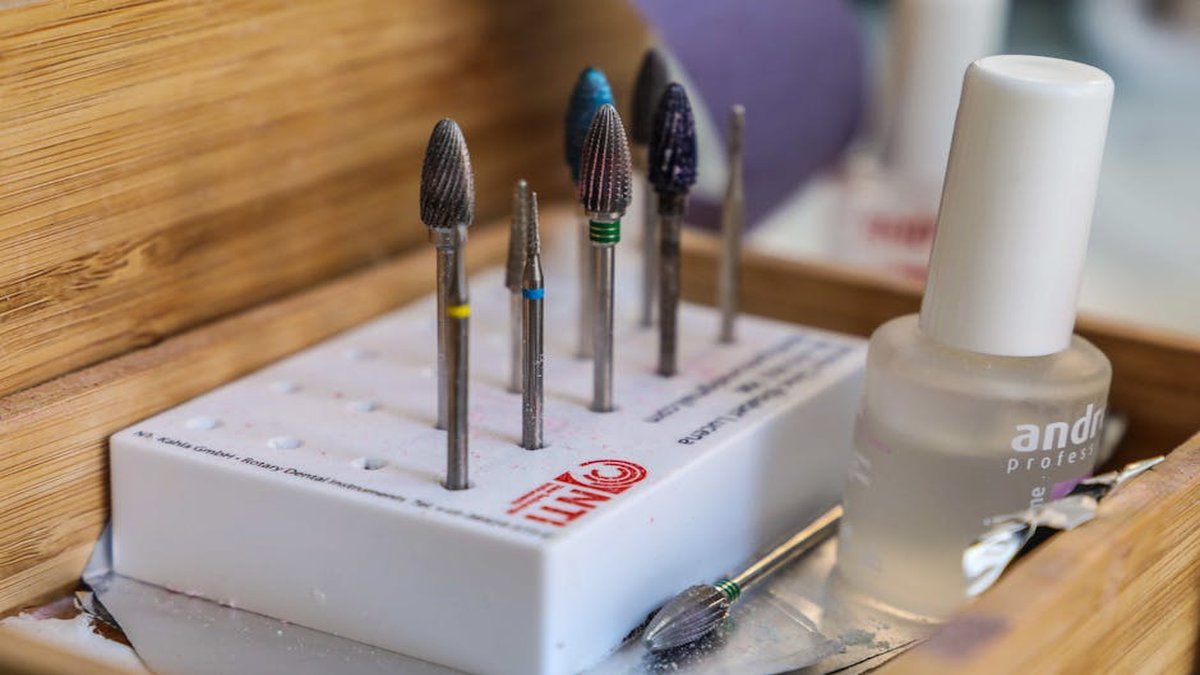
Photo by Silberfuchs on Pixabay
Here is your shopping list. Every item below is essential for a basic gel nail application. We cover each in detail in the sections that follow.
| English Name | Japanese Name | Role | Budget (¥) | Pro (¥) |
|---|---|---|---|---|
| LED Lamp | LEDライト | Cures (hardens) gel | ¥2,000-3,000 | ¥8,000-15,000 |
| Nail File (180 grit) | ネイルファイル / 爪やすり | Shapes the nail | ¥100-300 | ¥500-800 |
| Sponge Buffer | スポンジバッファー | Smooths nail surface | ¥100-200 | ¥300-500 |
| Cuticle Pusher | キューティクルプッシャー | Pushes back cuticles | ¥100-300 | ¥1,000-2,000 |
| Cuticle Nipper | キューティクルニッパー | Trims excess cuticle | ¥500-1,000 | ¥3,000-8,000 |
| Cuticle Remover | キューティクルリムーバー | Softens cuticles | ¥300-500 | ¥800-1,200 |
| Ethanol / Cleanser | エタノール / クレンザー | Cleans and dehydrates nail | ¥300-500 | ¥500-800 |
| Base Gel | ベースジェル | Adhesion layer | ¥500-1,000 | ¥1,500-3,000 |
| Color Gel | カラージェル | Color layer | ¥300-800 | ¥1,000-2,500 |
| Top Gel | トップジェル | Sealing layer | ¥500-1,000 | ¥1,500-3,000 |
| Gel Brush | ジェルブラシ / 平筆 | Applies gel | ¥300-500 | ¥800-2,000 |
| Wood Sticks | ウッドスティック | Cleanup and detail work | ¥100-200 | ¥200-400 |
| Nail Oil | ネイルオイル | Post-care moisturizing | ¥300-500 | ¥1,000-2,500 |
| Dust Brush | ダストブラシ | Removes filing dust | ¥100-300 | ¥500-1,000 |
Total budget kit cost: approximately ¥5,000-8,000 ($33-53 USD) Total professional kit cost: approximately ¥20,000-40,000 ($133-267 USD)
Category 1: Nail Preparation Tools
These are the tools you use before any gel touches the nail. Proper preparation is the single biggest factor in gel nail longevity — a perfect gel application on a poorly prepared nail will lift within days.
Nail File (ネイルファイル / 爪やすり)
What it does: Shapes the free edge of the nail and, for gel preparation, lightly roughens the nail surface to create grip for the base gel.
Grit guide:
- 100-150 grit: Coarse. For shortening very long nails or shaping acrylic/hard gel extensions. Too aggressive for natural nails.
- 180 grit: Medium. The standard for shaping natural nails and light surface preparation. This is the one grit you need as a beginner.
- 240 grit: Fine. For final smoothing and shaping. Useful but not essential for beginners.
Japanese product labels decoded:
- エメリーボード (emery board) = flat, disposable nail file
- ファイル (file) = any nail file
- グリット (grit) = grit number
- 爪やすり = literally "nail file"
Budget pick: Seria (100-yen shop) disposable emery boards — ¥110 for a multi-pack. These are surprisingly capable for basic shaping.
Pro pick: Nail Labo Crystal File (クリスタルファイル) — a glass file that lasts indefinitely, produces a smoother edge than sandpaper-type files, and is washable. ¥800-1,200.
Sponge Buffer (スポンジバッファー)
What it does: After filing, the sponge buffer smooths the nail surface and removes the shine (gloss) from the natural nail plate. This "de-glossing" step (サンディング, "sanding") is essential for most base gels — the matte surface created by buffing gives the base gel something to grip.
Important note: Some Japanese base gels are "non-sanding" (ノンサンディング), meaning they adhere to smooth, unbuffed nails. If you use a non-sanding base gel, you can skip the sponge buffer step. Non-sanding bases are increasingly popular in Japan because they reduce nail damage.
Budget pick: Seria or DAISO sponge buffers — ¥110 each.
Pro pick: Nail Labo 4-Way Buffer (4ウェイバッファー) — a multi-sided buffer with different grits on each face for progressive smoothing. ¥500.
Cuticle Pusher (キューティクルプッシャー)
What it does: Pushes back the cuticle (thin skin that grows over the base of the nail) to expose the full nail plate. This is critical because gel applied over cuticle skin will lift — gel needs to bond to nail, not skin.
Types:
- Metal pusher (メタルプッシャー): The professional standard. Durable, precise, washable. The spoon-shaped tip glides along the nail surface.
- Wood stick (ウッドスティック): A wooden orange stick that doubles as a cuticle pusher. Gentler than metal but less precise. Good for beginners who are nervous about pressing too hard.
- Ceramic pusher (セラミックプッシャー): Gently removes cuticle while pushing. Less common but popular among Japanese self-nailists.
Budget pick: Wood sticks (ウッドスティック) from any 100-yen shop — ¥110 for a pack of 10-20. These are single-use and gentle.
Pro pick: Nail Labo Stainless Steel Cuticle Pusher — ergonomic handle, precision tip. ¥1,500-2,000.
Cuticle Nipper (キューティクルニッパー)
What it does: Trims excess cuticle and hangnails after pushing. This is a precision cutting tool — the blades are extremely small and sharp.
Beginner warning: Cuticle nippers are the one tool in this kit that can injure you if misused. Cut only the transparent, dead cuticle that has separated from the nail. Never cut into pink, living tissue. If you are uncomfortable using nippers, you can skip this tool entirely — many Japanese self-nailists push cuticles back and dissolve excess with cuticle remover rather than cutting.
Budget pick: A basic stainless steel nipper from a Japanese drugstore — ¥500-1,000. Look for 甘皮切り (cuticle cutter) on the label.
Pro pick: Nail Labo or Maruto (マルト) nippers — Japanese-made precision nippers forged from surgical stainless steel. ¥3,000-8,000. The quality difference is real — professional nippers maintain their edge far longer and cut more cleanly, reducing the risk of tearing cuticle.
Cuticle Remover (キューティクルリムーバー)
What it does: A liquid applied to the cuticle area that softens and dissolves dead cuticle tissue, making it easier to push back and remove. Apply, wait 1-2 minutes, then push cuticles back.
Budget pick: Seria cuticle remover gel — ¥110. Functional and effective.
Pro pick: PREGEL Cuticle Remover or Ducato Cuticle Remover — ¥800-1,200. The professional formulas soften cuticles faster and more thoroughly.
Ethanol / Cleanser (エタノール / クレンザー)
What it does: Two related uses: (1) cleaning the nail plate before gel application to remove natural oils that interfere with adhesion, and (2) wiping the inhibition layer (sticky residue) from cured standard gel. If you use no-wipe (ノンワイプ) gel, you only need the cleanser for the pre-application wipe.
Product label guide:
- エタノール (ethanol) = generic ethanol, available at Japanese pharmacies
- クレンザー (cleanser) = nail-specific cleanser, often ethanol-based with additional ingredients
- 消毒用エタノール = "disinfecting ethanol" (the pharmacy version)
Budget pick: Pharmacy ethanol (消毒用エタノール) — ¥300-500 for a 500ml bottle. This works perfectly for nail prep.
Pro pick: PREGEL Prep or Leafgel Premium Cleanser — ¥500-800. Nail-specific formulas may include dehydrating agents for improved gel adhesion.
Category 2: Gel Products
 Pregel Nail Polish Pure Series — Japanese gel polish bottles designed for professional application. Photo courtesy of Preanfa America.
These are the products that go on the nail during the gel application process.
Base Gel (ベースジェル)
What it does: The first gel layer, applied directly to the prepared natural nail. Its job is adhesion — bonding to the nail and providing a foundation for color and top layers.
Types:
- Standard base gel (通常ベースジェル): Requires sanding/buffing the nail surface first. Stronger adhesion.
- Non-sanding base gel (ノンサンディングベースジェル): Adheres to smooth, unbuffed nails. Gentler on the nail. Increasingly popular.
- Peel-off base gel (ピールオフベースジェル): Allows easy removal — the entire gel set peels off without soaking or filing. Weaker adhesion (lasts 1-2 weeks vs 3-4 weeks for standard). Popular among self-nailists who change designs frequently.
Budget pick: Seria or Three Coins base gel — ¥110-330. These are peel-off type, lasting 5-10 days. Great for practice.
Pro pick: Leafgel Premium Base Gel (non-sanding) — ¥2,500-3,000. This is one of the most respected base gels in the Japanese professional market. It adheres to smooth nails without sanding and is compatible with the fill-in method that Japanese salons use for 4-6 week maintenance cycles.
PREGEL Base Gel is another professional standard — designated as an official product for JNA gel nail certification exams. Learn more about what those certifications mean in our Japanese nail certification guide.
Color Gel (カラージェル)
What it does: The color layer. Applied over the base gel in 1-2 coats.
Japanese gel types by consistency:
- Container type (コンテナタイプ): Gel in a pot, applied with a separate brush. Gives the most control. This is the professional standard in Japan.
- Bottle type (ボトルタイプ): Gel in a bottle with a built-in brush, like nail polish. Easier for beginners but less precise.
Budget pick: Three Coins (スリーコインズ) gel colors — ¥330 each. The brand's recent nail product line has gained a strong following among Japanese beauty bloggers for quality-to-price ratio. They also offer magnet gel variants for more advanced designs.
Pro pick: PREGEL Muse Color Series — ¥1,800-2,500 per pot. Over 200 colors with exceptional pigmentation, smooth application, and low heat curing. This is the color gel that most JNA-authorized schools use for instruction.
Top Gel (トップジェル)
What it does: The final layer that seals and protects the design. Provides gloss, scratch resistance, and longevity.
Types:
- Standard top gel (拭き取りトップジェル): Cures with a sticky inhibition layer that must be wiped with cleanser. Slightly more flexible, which some nailists prefer for natural nail movement.
- No-wipe top gel (ノンワイプトップジェル): Cures to a clean, non-sticky finish with no wiping. Produces the glossiest result. Required for mirror nail technique and preferred for maximum shine.
- Matte top gel (マットトップジェル): Cures to a matte, velvety finish. Used for specific design effects.
Budget pick: Seria or Three Coins no-wipe top gel — ¥110-330.
Pro pick: Vetro No-Wipe Top Gel — ¥2,500-3,000. Cures to the hardest, glossiest surface in the Japanese professional market. This is the top gel that most high-end salons use for the final finish.
Category 3: Application Tools
LED Lamp (LEDライト)
 KOKOIST LE BLANC Hybrid LED/UV Cordless Light — a Japanese professional-grade curing lamp. Photo courtesy of KOKOIST USA.
What it does: Cures (hardens) UV or LED gel through photopolymerization. LED lamps cure faster than UV lamps (30-60 seconds vs 2-3 minutes) and have a longer lifespan.
Wattage guide:
- 6-12W: Mini lamps. Cure one nail at a time. Slow but portable and cheap.
- 36-48W: Standard. Cure 4-5 nails simultaneously. Recommended for home use.
- 48-72W: Professional. Fastest cure times, most even coverage. Used in salons.
Important wavelength note: LED gels cure at specific wavelengths (typically 365nm and/or 405nm). Most Japanese gel brands formulate for the 405nm LED wavelength. Ensure your lamp covers this wavelength. Most modern LED nail lamps do, but ultra-budget lamps may not.
Budget pick: A 36W LED lamp from Amazon Japan or Rakuten — ¥2,000-3,000. Look for ジェルネイル用LEDライト (LED light for gel nails) with 4-finger capacity.
Pro pick: SHINYGEL Professional LED Lamp 36W — ¥8,000-12,000. SHINYGELis a Japanese brand that builds its lamps specifically for compatibility with Japanese gel formulas. Their lamps feature 365nm + 405nm dual-wavelength LEDs.
Gel Brushes (ジェルブラシ / 平筆)
 KOKOIST Camellia Brush — Japanese-made precision gel brush for detailed nail art application. Photo courtesy of KOKOIST USA.
What it does: Applies gel from the container to the nail. Different brush shapes serve different purposes.
Essential brushes:
- Flat brush (平筆 / ひらふで): The standard application brush. A flat, square-tipped brush for applying base, color, and top gel. This is the only brush a beginner needs.
- Art brush (アート筆 / アートふで): A thin, pointed brush for detail work — lines, dots, fine designs. Not essential for beginners but useful if you want to try nail art.
- Liner brush (ライナー筆): An ultra-thin brush for hair-thin lines. Used in advanced nuance nail techniques.
Budget pick: Seria gel brush set — ¥110 for a flat brush and art brush. These are disposable-quality but functional for practice.
Pro pick: Nail Labo Kolinsky Hair Gel Brushes — ¥1,000-2,000 per brush. Kolinsky hair (from the Kolinsky sable) is the premium brush material — it holds gel evenly, applies smoothly, and maintains its shape over hundreds of uses. Japanese-made Kolinsky brushes are considered among the finest in the world.
Wood Sticks (ウッドスティック)
What it does: A disposable wooden stick with a pointed end and a flat end. Used for: pushing cuticles (gentler alternative to metal pusher), cleaning up gel overflow before curing, pressing down lifted edges, and placing small decorations.
Budget pick: Any 100-yen shop — ¥110 for a pack of 10-20.
Pro pick: They are all the same. Wood sticks are a consumable — there is no premium version. Buy in bulk.
Dust Brush (ダストブラシ)
What it does: A soft-bristled brush for sweeping filing dust off the nail and fingers after the prep step. Using your hands or blowing creates contamination issues — the brush provides a clean removal method.
Budget pick: Any soft brush from a 100-yen shop works. Some beginners use a clean, soft makeup brush.
Pro pick: Nail Labo Dust Brush — ¥500-800. Slightly denser bristles for more thorough dust removal.
Category 4: Post-Care
Nail Oil (ネイルオイル)
What it does: Moisturizes the cuticle and surrounding skin after gel application. Gel prep involves dehydrating the nail, and cuticle pushing/cutting can leave the skin dry and irritated. Nail oil restores moisture and promotes healthy cuticle regrowth.
When to use: After every gel application session. Also daily between salon visits for maintenance.
Budget pick: DAISO Nail Oil — ¥110. Basic but effective.
Pro pick: OPI ProSpa Nail & Cuticle Oil or a Japanese brand like Uka (ウカ) Nail Oil — ¥1,500-3,000. Uka in particular is a prestigious Japanese beauty brand whose nail oils are formulated with high-quality botanical oils and have a following among Tokyo's fashion-conscious.
Starter Kits vs. Individual Purchasing
Japanese nail supply retailers offer two paths for beginners:
Starter Kits (スターターキット / ジェルネイルキット)
Pre-assembled kits containing a lamp, base gel, top gel, several color gels, brushes, and basic tools. Available from ¥3,000-15,000 depending on quality and contents.
Advantages: Convenient, cost-effective (usually cheaper than buying individually), and everything is guaranteed to be compatible.
Disadvantages: Kit products are often lower quality than what you would choose individually. Color selections may not match your preferences. The lamp included in budget kits is often underpowered.
Best starter kits (Japanese market):
- Three Coins Gel Nail Set — ¥1,320 for a basic set including colors and top coat. Add a lamp separately.
- SHINYGEL Starter Kit — ¥8,000-12,000 for a complete professional-quality kit with lamp, gels, and tools. This is the premium beginner option.
- Nail Town Starter Kit — ¥5,000-8,000 for a mid-range kit with good color variety and a functional 36W lamp.
Individual Purchasing (個別購入)
Buying each tool and product separately. This approach costs more initially but lets you choose exactly the quality level you want for each item.
Recommended strategy for beginners: Buy a budget starter kit to learn the basics. Once you understand what each tool does and which products matter most to you, upgrade individual items to professional quality. Most experienced self-nailists end up with a mix of budget and premium items — premium base gel and top gel (where quality matters most), mid-range color gels (where variety matters more than individual quality), and budget prep tools (where the item is disposable anyway).
Where to Buy Japanese Nail Tools
In Japan
- 100-yen shops (Seria, DAISO, Can Do): Basic tools, peel-off base gels, simple color gels. Quality varies but Seria's nail line is consistently recommended by Japanese beauty bloggers.
- Three Coins (スリーコインズ): 300-yen shop with a surprisingly strong nail gel line. Their magnet gels in particular have gained a following.
- Loft / PLAZA / Tokyu Hands: Mid-range nail products, including Japanese and international brands. Good for browsing and discovering products in person.
- Don Quijote (ドン・キホーテ): Japan's discount megastore carries nail products at competitive prices.
- Professional nail supply shops (ネイル問屋): TAT (Nail ティーエーティー), Nail Labo, NES Online Shop — these are wholesale/professional retailers. Some require proof of certification to purchase.
Online (International Shipping)
- Rakuten Global Market: Japan's largest e-commerce platform with international shipping. Search in Japanese for the widest selection.
- Amazon Japan (amazon.co.jp): Ships many products internationally. Create a Japan-specific account.
- Nail supply specialty sites: Some Japanese professional shops (like Nail Labo) offer international shipping for consumer products.
Language tip: When searching Japanese sites, use the Japanese tool names from the table at the top of this guide. Searching in English on Japanese sites returns limited results. Searching ジェルネイル スターターキット (gel nail starter kit) on Rakuten returns 10x more results than the English equivalent.
The Order of Operations: Your First Gel Nail Session
Here is the complete sequence for a basic one-color gel nail application, using the tools from this guide in the order you will use them:
- Cuticle remover → apply to all 10 nails, wait 2 minutes
- Cuticle pusher → push back softened cuticles on all nails
- Cuticle nipper → trim any excess (optional)
- Nail file (180 grit) → shape the free edge of each nail
- Sponge buffer → lightly buff the nail surface (skip if using non-sanding base)
- Dust brush → sweep away all filing dust
- Ethanol / cleanser → wipe each nail to remove oils and dust
- Base gel + LED cure → apply base gel, cure 30-60 seconds
- Color gel + LED cure → apply first coat, cure 30 seconds. Apply second coat, cure 30 seconds
- Top gel + LED cure → apply top gel, cure 60 seconds
- Wipe (if using standard top gel) → wipe with cleanser-soaked lint-free pad
- Nail oil → apply to cuticles and massage in
Total time for a beginner: 60-90 minutes for all 10 nails. With practice: 30-45 minutes.
Japanese vs. Western Nail Tools: What Makes Them Different
A common question from beginners outside Japan: is there actually a difference between Japanese nail tools and Western equivalents, or is it just branding?
The difference is real, particularly in three categories:
Gel Formulation
Japanese gels (from brands like PREGEL, Leafgel, Vetro, and Shinygel) are formulated differently from most Western gels. Key differences:
Viscosity. Japanese gels tend to be slightly thicker and more self-leveling than Western gels. This means they settle into a smooth, even surface after application, reducing brush marks. The thicker consistency also gives more working time before the gel begins to thin out.
Curing chemistry. Japanese gels are optimized for LED curing at 405nm, with formulas designed to minimize heat generation during polymerization. "Low-heat" (低発熱) is a selling point on Japanese gel products because heat spike during curing is a common complaint among clients with thin or damaged nails. Western gel brands are catching up on this front, but Japanese brands have been formulating for low-heat since the early 2010s.
Adhesion philosophy. Japanese gel culture has embraced the non-sanding (ノンサンディング) approach more aggressively than Western markets. Brands like Leafgel Premium and Parasol are designed to adhere to smooth, unbuffed nails, which reduces natural nail damage over repeated gel cycles. The Western market still heavily relies on sanding for adhesion, though non-sanding products are gaining ground.
Brush Quality
Japanese gel brushes — particularly those from Nail Labo and specialty brush makers — use Kolinsky sable hair or high-grade synthetic fibers that maintain their shape through hundreds of uses. The brush tips are cut and shaped with precision that affects gel pickup and lay-down. A high-quality Japanese brush applies gel more evenly and with better control than a generic brush, which directly translates to a smoother finish.
Tool Precision
Japanese cuticle nippers, pushers, and files are manufactured to tighter tolerances than mass-market Western equivalents. Maruto (マルト) nippers, for example, are hand-forged in Niigata Prefecture — the same region famous for Japanese kitchen knife production — using similar steel and craftsmanship traditions. The cutting edges are sharper and maintain their edge longer than machine-stamped nippers.
This precision is not luxury for luxury's sake. In the Japanese nail certification system, practical exams are scored on finish quality at a granular level. A nailist's tools directly affect their ability to produce examination-standard results. The demand for precision drives tool quality upward.
Maintenance and Care for Your Tools
Investing in quality tools is pointless if you do not maintain them. Here is how to keep your kit in working condition:
Gel brushes: Clean immediately after each use. Wipe the brush on a lint-free pad dampened with gel cleanser. Never let gel cure on the brush — a cured gel brush is ruined. Store brushes with caps on, bristles down or horizontal (never bristles-up, which allows cleanser to seep into the ferrule and loosen the bristles).
Metal tools (pushers, nippers): Wipe with ethanol after each use. Dry completely before storage — stainless steel resists rust but is not immune. Professional nippers should be oiled at the hinge point every few weeks with a drop of machine oil. Store in a case or pouch to protect cutting edges.
LED lamp: Clean the reflective interior with a dry cloth periodically. Check that all LED bulbs are functioning — a dead bulb creates an uneven cure. Most LED bulbs last 30,000-50,000 hours, so replacement is rare for home users.
Files and buffers: Disposable files should be replaced when grit wears smooth (typically after 5-10 uses for emery boards). Glass files can be cleaned with soap and water and last indefinitely. Sponge buffers should be replaced monthly — they absorb oils and debris that compromise their effectiveness.
Frequently Asked Questions
Do I need a UV lamp or an LED lamp?
LED. Almost all modern Japanese gel brands formulate for LED curing. LED lamps cure faster (30-60 seconds vs 2-3 minutes for UV), last longer (the LEDs themselves do not degrade like UV bulbs), and use less energy. The only situation where you might need UV is if you are using a very old gel formula that specifies UV-only curing. For any current Japanese gel product, LED is the correct choice.
Can I use 100-yen shop (DAISO/Seria) gels for my first time?
Yes, with caveats. 100-yen shop gels are fine for learning the basic technique — how to apply gel, how curing works, how to clean up mistakes. However, they are typically peel-off base formulas that last 5-10 days rather than 3-4 weeks. The color pigmentation and consistency are also lower than professional gels. Think of 100-yen shop gels as training tools. Once you are comfortable with the process, upgrade to mid-range or professional gels for lasting results.
What is the most important tool to invest in?
The base gel. Everything else in your kit can be budget without significantly affecting results, but a poor base gel means poor adhesion, which means lifting, peeling, and a manicure that does not last. If you spend professional money on one item, make it the base gel. Leafgel Premium and PREGEL are the two most recommended base gels among Japanese professionals.
How do I read Japanese product labels?
Key label terms:
- ベースジェル = base gel
- トップジェル = top gel
- カラージェル = color gel
- ノンワイプ = no-wipe
- ノンサンディング = non-sanding (no buffing needed)
- ピールオフ = peel-off (easy removal)
- 硬化時間 = curing time
- LED対応 = LED compatible
- 内容量 = volume/amount
- 全成分 = full ingredient list
What tools do I NOT need as a beginner?
Skip these until you are ready for advanced techniques: nail drill (ネイルドリル/マシン) — powerful but risky for beginners who can easily damage natural nails; nail forms (ネイルフォーム) — only needed for sculpted extensions; 3D gel and acrylic liquid/powder — advanced art materials; and specialized art tools like dotting pens, striping brushes, and foil adhesive — these are for specific techniques you can explore after mastering the basics.
Related Reading
- Japanese Gel Nail Art: Unique Techniques
- PREGEL vs Leafgel vs Vetro: Japanese Gel Comparison
- Japanese Nail Certification: JNA and JNE Guide
Explore Your Style
Ready to start your Japanese nail journey? Use our Product Finder to source the Japanese tools and gels recommended in this guide, take our Style Quiz to discover which Japanese nail style matches your aesthetic, or browse our Technique Guide for step-by-step video tutorials of basic and advanced techniques.
— The Nail Atlas Team