Japanese Bridal Nail Art: The Wedding Nail Traditions of Japan
- Japanese bridal nails (ブライダルネイル) follow distinct aesthetic rules that differ from both everyday nail art and Western bridal nails — emphasizing elegance, restraint, and photography-readiness over maximum decoration
Quick Answer
- Japanese bridal nails (ブライダルネイル) follow distinct aesthetic rules that differ from both everyday nail art and Western bridal nails — emphasizing elegance, restraint, and photography-readiness over maximum decoration
- The ideal timing for bridal nails is 3–5 days before the ceremony, allowing the gel to fully settle while minimizing visible nail growth on the wedding day
- Bridal nail salon prices range from ¥8,000–20,000 (~$54–135 USD) depending on design complexity, with premium bridal-specialist salons in Ginza and Omotesando charging ¥15,000–30,000 (~$101–202 USD)
- The 2025 Japanese bridal nail trends emphasize subtle shimmer over sparkle — aurora powder finishes, pearl accents, and champagne French tips are displacing the heavy rhinestone and Swarovski designs of the previous decade
Japanese Bridal Nail Culture
In Japan, bridal nails aren't an afterthought. They're a planned element of the wedding aesthetic, coordinated with the dress, bouquet, and venue. Bridal magazines like ゼクシィ (Zexy) dedicate entire sections to nail design, and many brides book their nail appointment before booking their hair stylist.
The reason: Japanese wedding photography is intensely detail-oriented. The ring exchange photo, the bouquet toss, the hand-on-the-table portrait — these shots zoom in on hands. And hands with nail art that clashes with the dress, outshines the ring, or looks dated in photos is a bride's nightmare.
This photography-first thinking drives the Japanese bridal nail aesthetic toward designs that:
- Complement the dress without competing
- Photograph well under flash and natural light
- Look elegant from both arm's length and close-up
- Don't overwhelm the wedding ring
How Japanese Bridal Nails Differ from Western Approaches
Western bridal nails tend toward two extremes: either very simple (plain French tips, nude polish) or very dramatic (elaborate 3D art, heavy crystals). There's less middle ground.
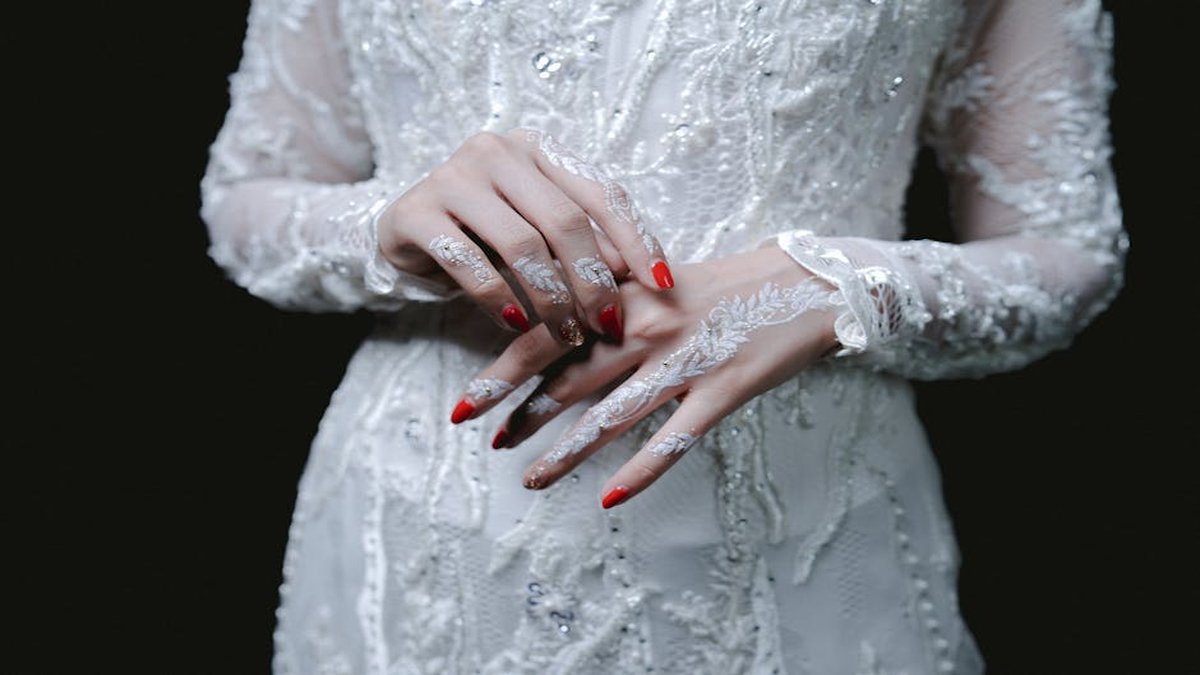
Japanese bridal nails occupy a sophisticated middle space — more detailed than Western simple, more restrained than Western dramatic. The art is there, but it whispers rather than shouts. A subtle aurora shimmer across all ten nails, two accent nails with delicate hand-painted lace, tiny pearl accents near the cuticle line — this is the Japanese bridal sweet spot.
The Core Bridal Nail Styles
1. Classic White French (クラシック フレンチ)
The foundation of Japanese bridal nails. But the Japanese interpretation differs from the American French manicure:
- Thinner line: The white tip is 1–2mm narrower than typical French, creating a more delicate look
- Soft white, not bright white: Japanese bridal French uses milky white (ミルキーホワイト) or ivory rather than pure stark white — it reads softer in photographs
- Curved smile line: The "smile line" (where pink meets white) follows a deeper, more pronounced curve than the flat American style — enhancing the elongation effect
Variations trending in 2025:
- Champagne French: Gold-tinted tip instead of white — warmer, more modern
- Mirror French: Thin chrome line at the free edge (see our mirror nails guide)
- V-French: V-shaped tip instead of curved — contemporary, minimalist
- Gradient French: No hard line — the white tip fades into the pink base
Salon price: ¥8,000–12,000 (~$54–81 USD).
2. Aurora Bridal (オーロラ ブライダル)
The hottest bridal nail trend in Japan for 2025. An aurora powder finish is applied over a sheer base to create an iridescent, opal-like shimmer that shifts color with movement.
Why it works for weddings: the subtle rainbow effect catches light beautifully in photographs without being flashy. It coordinates with any dress color because the iridescence contains traces of every color.
Variations:
- Full aurora: All 10 nails in aurora over milky white base
- Aurora accent: 8 nails in nude/pink, 2 accent nails in aurora
- Aurora French: French tip line with aurora powder instead of white
Salon price: ¥10,000–15,000 (~$67–101 USD).
3. Pearl Accent (パール アクセント)
Small pearl elements — either actual tiny pearl studs or pearl-finish paint — placed strategically on 2–4 nails. Pearl is the quintessential bridal material in Japanese culture, and nail art pearl accents visually connect to pearl earrings, necklaces, or dress details.
Placement rules:
- Pearls near the cuticle line on the ring finger (draws the eye toward the ring)
- Single pearl per accent nail — less is more
- 3mm size maximum — larger pearls look costume-like in close-up photos
Salon price: ¥8,000–12,000 (~$54–81 USD).
4. Lace and Floral Art (レース・フラワーアート)
Hand-painted lace or floral patterns on accent nails. This is where the Japanese bridal nail artist's skill is most visible — the lace must be delicate enough to look real, not stamped.
Popular styles:
- White lace pattern on 2 nails over nude base
- Tiny rose clusters (バラ) on ring finger
- Cherry blossom (桜) for spring weddings
- Hydrangea (紫陽花) for June weddings (紫陽花 is the traditional rainy season flower)
This technique overlaps with Japanese seasonal nail art design philosophy, where the nail design reflects the time of year.
Salon price: ¥12,000–20,000 (~$81–135 USD) — hand-painted lace requires significant time and skill.
5. Nuance Bridal (ニュアンス ブライダル)
A bridal adaptation of nuance nail art — soft, blended, abstract washes of color that create a dreamy, watercolor effect. For bridal use, the colors stay in the white/cream/champagne/pale pink family.
Why brides love it: The organic, unstructured look photographs as art — every photo shows the nails slightly differently as light and angle change. It also avoids the "dated" risk of very specific design trends.
Salon price: ¥10,000–15,000 (~$67–101 USD).
6. Bijou Ring Art (ビジューリング アート)
A design element specific to bridal nails: a ring of stones, pearls, or metallic elements around the nail at the base — visually echoing the wedding ring. Usually placed on the ring finger only. The "nail ring" catches light in ring exchange photographs, creating visual continuity between the nail art and the actual ring.
Salon price: ¥12,000–18,000 (~$81–121 USD).
Wedding Timeline: When to Get Your Nails Done
Japanese bridal planning is precise, and nail timing is critical:
3 Months Before: Trial (トライアル)
Most Japanese brides do a trial appointment with their chosen salon. This involves:
- Discussing the dress, color scheme, and overall wedding aesthetic
- Trying 2–3 potential designs on practice tips or a few nails
- Checking how designs look in photographs under different lighting
- Getting a price quote for the final design
Cost: ¥3,000–5,000 (~$20–34 USD) for a consultation/trial session.
1 Month Before: Final Design Confirmation
Confirm the exact design with the salon. Bring photos of the final dress, bouquet, and accessories. The nail artist adjusts the design to complement these elements.
3–5 Days Before: Application
This is the sweet spot. Three days allows the gel to fully settle and any minor adjustments to be made. Five days is the maximum — beyond that, nail growth at the cuticle becomes visible in close-up photographs.
For destination weddings in Japan: If you're traveling to Japan for a wedding, book a Tokyo or Osaka salon through ホットペッパービューティー using the search term "ブライダルネイル." Many salons in 銀座 (Ginza), 表参道 (Omotesando), and 青山 (Aoyama) specialize in bridal services and accommodate international clients. Our salon pricing guide covers booking logistics.
After the Wedding: Removal
Schedule gel removal 1–2 weeks after the wedding. Some brides keep their bridal nails for the honeymoon, switching to a simpler design afterward.
Matching Nails to the Wedding Style
Photo by NGDPhotoworks on Pixabay
White Dress (ウェディングドレス)
The Western-style white dress ceremony is the most common wedding format in Japan (chosen by approximately 70% of couples, according to ゼクシィ 2024 survey data).
Best nail designs: White French, aurora over pink base, pearl accents, white lace art. Keep nails lighter than or equal in brightness to the dress — dark nails against a white dress create jarring contrast in photos.
Colorful Dress (カラードレス)
Many Japanese brides change into a colored dress for the reception (お色直し). Common colors: champagne gold, dusty rose, sage green, lavender.
Nail strategy: Choose a nail design that works with both the white ceremony dress and the reception color dress. Aurora nails excel here because the iridescent finish contains traces of every color. Alternatively, nude/champagne nails are universally neutral.
Japanese Kimono (和装/白無垢/色打掛)
Traditional Japanese wedding attire — either the all-white 白無垢 (shiromuku) or the colorful 色打掛 (irouchikake) — pairs best with specific nail styles:
- Shiromuku (white kimono): Pure white nails, minimal art. The formality of the white kimono demands absolute simplicity. French tips or one-color white gel.
- Irouchikake (colored kimono): Red and gold accent nails complement the kimono's traditional palette. Subtle Japanese motifs — cherry blossoms, cranes (鶴), pine (松) — hand-painted on accent nails connect nail art to kimono symbolism.
Nail Chip Options for Brides
Not every bride wants gel nails. Japanese nail chip (ネイルチップ) technology offers a compelling alternative:
Advantages:
- Can be designed months in advance
- No salon appointment needed on the wedding week
- Reusable — keep as a memento
- Zero damage to natural nails
Premium bridal chip services: Many Japanese nail artists sell custom bridal chips through their websites or Instagram. The bride sends dress photos, and the artist creates a set of 10 custom-designed press-on nails.
Price: ¥5,000–15,000 (~$34–101 USD) for a custom bridal chip set — often less than a salon appointment.
Application tip: Use double-sided nail adhesive tabs rather than nail glue for a damage-free, removable fit. Apply 1–2 hours before the ceremony for maximum hold.
For at-home nail options beyond chips, see our best Japanese nail tools guide and the HOMEI peel-off gel review.
Related Reading
- Japanese Nail Art Menu Translation Guide
- Japanese Seasonal Nail Art Designs Guide
- Japanese vs American Nail Salons Comparison
Frequently Asked Questions
How much do Japanese bridal nails cost?
Standard bridal nail designs at mainstream Japanese salons cost ¥8,000–15,000 ($54–101 USD). Premium bridal-specialist salons in Tokyo's Ginza, Omotesando, and Aoyama areas charge ¥15,000–30,000 ($101–202 USD) for elaborate hand-painted designs, custom stone work, and extensive consultation. Additional costs may include the trial appointment (¥3,000–5,000) and post-wedding removal (¥2,000–5,000 if done at a different salon). Some salons offer "bridal packages" that bundle trial + application + removal for a slight discount.
Should I get my bridal nails before or after the wedding rehearsal? After. The wedding rehearsal may involve physical activity (setting up, moving items) that risks chipping fresh gel. The ideal timeline: rehearsal first, then nails 3–5 days before the ceremony. If the rehearsal is less than 3 days before the wedding, get nails done after the rehearsal but at least 24 hours before the ceremony to allow the gel to fully harden.
Can I match my bridal nails to my bouquet? This is a popular approach in Japanese bridal nail planning. If your bouquet features roses, ask the nail artist to hand-paint small roses on your accent nails. If the bouquet uses seasonal flowers like hydrangea or cherry blossom, the nails can mirror this. The key is subtlety — tiny floral accents on 2 nails, not a full botanical garden across all 10. Bring a photo of your final bouquet to the nail consultation for the closest match.
Are nail chips (press-ons) appropriate for a Japanese wedding? Absolutely. Modern Japanese nail chips, especially custom-ordered ones from professional nail artists, are virtually indistinguishable from salon gel in photographs. Many Japanese brides prefer chips because they can be designed well in advance (reducing wedding-week stress), require no salon appointment, cause zero nail damage, and can be kept as a memento. The quality of Japanese nail chip artistry — including 3D elements, delicate lace patterns, and Swarovski accents — rivals or exceeds what many salons offer.
What nail shape is best for Japanese bridal nails? Round (ラウンド) and oval (オーバル) are the most recommended bridal shapes by Japanese nail technicians. Both create a soft, feminine silhouette that photographs well and complements the gentle aesthetic of bridal designs. Square shapes are less common for Japanese weddings as they can appear harsh in soft-focused bridal photography. For short-nailed brides, oval provides the most elongation without requiring length extensions.
— The Nail Atlas Team
Related Reading from our editorial team:
- Top 10 Japanese Nail Art Trends & Styles to Try in 2026 (Magazine Decoded)
- Top 10 Tokyo Nail Studios with English Booking Compared: Tourist-Friendly Salons (2026)
- Top 10 Japanese Gel Nail Polish Brands Compared: Para Gel, Pre Gel, Calgel (2026)
- Top 10 Japanese Nail Art Online Courses Compared: Skill Level, Cost, English Subtitles (2026)
- Top 10 Japanese Nail Tools & Art Supplies Compared: Brushes, Stickers, Foils, Stones (2026)